QQQ Stock Price Tests Support While Cheaper Clone QQQM Waits
Track how the QQQ stock price sits on a key technical floor, why Micron dragged the fund lower, and what a fee gap of 3 basis points means for buy-and-hold investors.

Key Takeaways
- QQQ sits at $637.89, almost exactly on its lower Bollinger Band, so the floor is being tested in real time.
- Every major moving average sits above the price, a clean bearish stack that buyers must climb back through.
- Reclaiming the $650.71 pivot and then $663.61 is what turns this selloff into a failed breakdown rather than a deeper leg lower.
- Micron's 5.6% slide helped drag QQQ down 1.7% on another session, proof that one big holding can tug a whole fund.
- QQQM tracks the same index at roughly 0.15% against QQQ's 0.18%, a small gap that compounds quietly.
- Four mega-caps drive QQQ's returns, a concentration cost that no fee line captures.
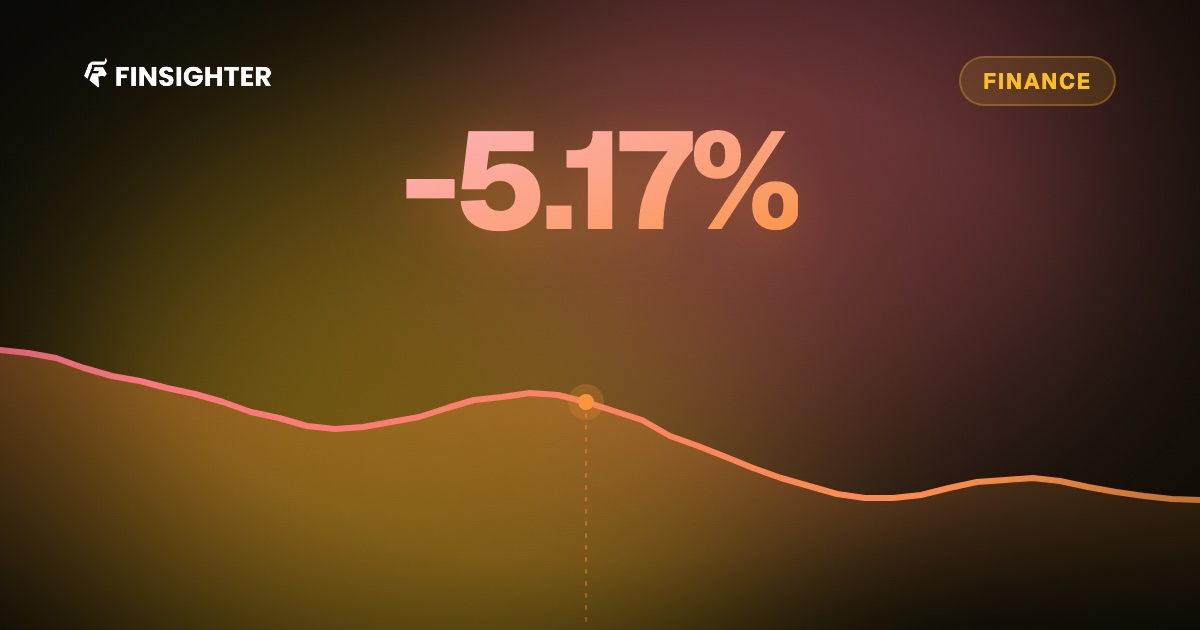
QQQ is having a rough stretch. The fund trades at $637.89 after a 5.17% slide in 24 hours, and the mood on the screen has turned cautious.
It sits a hair above its lower Bollinger Band and below every major moving average. Micron's slump added weight on another session, while a quiet fee gap with its cousin QQQM keeps nagging at long-term holders.
So what is the tape saying, and what is the fee line hiding? Let's get started.
Testing QQQ Stock Price Support
Picture a ball bouncing down a staircase that suddenly hits a landing. That is QQQ today, resting almost exactly on its lower Bollinger Band after a sharp one-day drop. The market is leaning on the floor, and everyone is watching whether it holds.
The fund changed hands at $637.89 against a band at $637.29, a gap thinner than a credit card. Below that line the map shows $624.99 as immediate support, and the stronger floor sits lower still. That is not much cushion for a fund that just shed so much in a day.
Yet a floor is only useful if buyers show up. A close back above the $650.71 pivot eases the pressure and makes this look like a failed breakdown. Until then, the burden of proof sits with buyers.
Reading the Trend Signals
Think of moving averages as the fund's recent footprints, and right now QQQ is walking below all of them. The short, medium and long trend markers all sit above the price, a clean bearish stack that leaves no room for spin.
Momentum agrees. The RSI reads 33.33, weak without being extreme, while the MACD stays negative and the stochastic readings hug the bottom of the range. Volume tells a quieter tale at 0.38x the recent average, more a low-volume pullback than a panic flush.
But a tired market is not a broken one. The daily ATR of $17.59 says sharp intraday swings remain on the menu, so a calm-looking tape can flip fast in either direction, and the bears have no guarantee of a smooth ride down.
Tracking Micron's Drag on QQQ
One stock can tug a whole fund. On another session, QQQ fell 1.7% as Micron slid 5.6% and acted as the heavy anchor. An index fund feels like a calm lake until a single big name drops a boulder in.
Micron's own paper trail is a study in contrasts. Insiders sold on the open market 207 times over six months and did not buy once, yet 14 firms rate the stock a buy and none rate it a sell. Insiders and analysts are reading from different scripts.
Neither camp settles the question. Insider selling is not a verdict, and analyst optimism is not a guarantee. Both simply remind you that a fund's mood often hangs on a handful of holdings.
Weighing QQQ Against QQQM
Two funds, one index, one issuer. QQQ and QQQM hold the same Nasdaq-100 stocks, like twin storefronts on one street selling identical goods at slightly different prices. Only the sticker differs, and stickers compound.
QQQ charges 0.18% after its December reclassification, while QQQM charges roughly 0.15%. That gap looks like rounding error on a factsheet. Over two decades of compounding, though, the cheaper twin leaves roughly $400 more per $10,000, and the old unit-trust structure added cash drag that QQQM never carried.
The catch is liquidity. QQQ offers deeper trading and a robust options market, which matters to active traders and covered-call writers. For a buy-and-hold investor who never touches options, that premium buys far less than the ticker's fame suggests.
Watching QQQ Stock Price Risks
Fees are the visible cost, and concentration is the hidden one. QQQ's returns lean on NVIDIA, Apple, Alphabet and Microsoft, so when that quartet wobbles, the whole portfolio feels the tremor, like a table with four legs where someone nudges one.
Late June offered a preview: a 4.60% five-day drop as Treasury yields rose. Positioning shows a similar tension today. Binance futures accounts are 69.6% long, yet open interest fell 9.81% in 24 hours, a sign some participants are stepping back even as the crowd stays bullish.
For a cheaper route into tech, VGT charges 0.09%, half the QQQ tab, though it drops Alphabet, Meta, Amazon and Costco. Different exposure, cheaper wrapper, and the same need to know exactly what you own before the next wobble.
Long Story Short
The QQQ stock price story right now is a standoff. The fund rests near $637.29 support with trend signals still negative, and the near-term read is entirely technical and positioning-led. No company catalyst has been supplied to change that. Beneath the chart sits the quieter story. Micron's slide showed how one holding can tug the whole fund, and the fee gap with QQQM shows how a small number keeps charging you year after year. Match the vehicle to how you actually invest. If you trade options or write covered calls, QQQ's liquidity earns its premium. If you buy and hold, the cheaper twin deserves a look. Watch the $650.71 pivot for relief and $637.29 for trouble, and keep a steady hand either way.